<?xml version="1.0" encoding="utf-8"?><feed xmlns="http://www.w3.org/2005/Atom" ><generator uri="https://jekyllrb.com/" version="3.10.0">Jekyll</generator><link href="http://neic.no/feed/" rel="self" type="application/atom+xml" /><link href="http://neic.no/" rel="alternate" type="text/html" /><updated>2026-11-03T09:34:36+00:00</updated><id>http://neic.no/feed/</id><title type="html">neic.no</title><subtitle>Sources behind https://neic.no, the official NeIC website.</subtitle><entry><title type="html">NeIC will retire at the end of 2026</title><link href="http://neic.no/news/2026/09/29/neic-is-ending/" rel="alternate" type="text/html" title="NeIC will retire at the end of 2026" /><published>2026-09-29T00:00:00+00:00</published><updated>2026-09-29T00:00:00+00:00</updated><id>http://neic.no/news/2026/09/29/neic-is-ending</id><content type="html" xml:base="http://neic.no/news/2026/09/29/neic-is-ending/"><![CDATA[<h1 id="neic-will-retire-at-the-end-of-2026">NeIC will retire at the end of 2026</h1>

<p>After 15 active and successful years, it has been decided that the Nordic e-Infrastructure Collaboration (NeIC) will be discontinued on 31 December 2026. The announcement was made by NeIC’s Strategic Committee in their meeting on 11 June, following a decision by the leaders of the Nordic e-infrastructure provider organisations on 9 June.</p>

<p>The decision does not reflect NeIC’s ability to fulfil its role but rather the changed e-infrastructure landscape. The national e-infrastructure providers nowadays collaborate directly on topics and in other contexts beyond NeIC, which has rendered the added value and distinct role of NeIC less clear. The lack of external funding and the participating organisations’ focus shifting from Nordic collaboration towards broader international cooperation have influenced the interest in collaboration through NeIC.</p>

<p>With current resources, it has proven challenging for NeIC to keep supporting meaningful and impactful e-infrastructure development projects.</p>

<h3 id="ongoing-projects-will-remain-running-at-csc">Ongoing projects will remain running at CSC</h3>

<p>Since its establishment in 2012, NeIC has been pivotal in strengthening and bringing together Nordic research e-infrastructures and enabling cross-border collaboration. Originally created to manage the Nordic Tier-1 facility, NeIC has expanded its activities to managing Nordic-Baltic projects in various key areas. NeIC also contributed considerably to NordForsk’s eScience Action plans, to further develop eScience and e-infrastructures in an international context across the Nordic region.</p>

<p>Starting in January 2025, NeIC has been hosted by CSC - IT Center for Science Ltd, and the activities have been aligned with the strategies and joint interests of the partner organisations: CSC, DeiC, ETAIS, NAISS, RHnet and Sigma2. Operations continue throughout 2026, with the addition of bringing people together around topics of shared interest through the newly established NeIC forums. The traditional staff gathering, NeIC All-hands meeting, will take place in Copenhagen in late October.</p>

<p>A particular priority has been on ensuring the continuation of the three development projects that extend beyond 2026: CodeRefinery, NordIQuEst and Puhuri. NeIC’s Strategic Committee has approved a proposal to use any and all savings from 2026 in running the projects until at least the end of 2027. As the legal entity behind NeIC, CSC has offered to seek and hire a coordinator to support the projects until their completion, and to continue providing some administrative services.</p>

<h3 id="a-true-privilege-to-work-with-neic">“A true privilege to work with NeIC”</h3>

<p>For 1,5 decades and through 31 development projects, NeIC has provided researchers with access to advanced computing resources, improved data-sharing capabilities and strengthened cross-border collaboration, and helped align Nordic efforts with major European initiatives such as EOSC and EuroHPC. NeIC’s Director <strong>Tomasz Malkiewicz</strong> emphasises that keeping the legacy alive and sustaining the outcomes of the collaboration is the main focus in the months leading up to closing down NeIC.</p>

<p>– It has been a true privilege to work with NeIC. In general, but also for me personally: first in charge of project portfolio and benefit realisation, and since two years ago, leading the organisation. What a journey it has been!</p>

<p>Having worked with NeIC since January 2017, Malkiewicz has witnessed the collaboration’s development up close. Over the years, NeIC evolved into a motivated community of digital infrastructure experts and researchers learning from one another; a platform to share experiences and common problems as well as solutions; an incubator of ideas; and an agile tool for the stakeholders to identify and pursue opportunities otherwise unreachable. Collaboration through NeIC has resulted in vast investments in Nordic computing infrastructure, fruitful testbeds and smooth uptakes with regard to European collaboration, and services solving issues too diverse and international for one single organisation to tackle alone.</p>

<p>– The evaluation by Technopolis in 2022 concluded we have managed to create significant Nordic Added Value by fostering collaboration, building competence, supporting scientific excellence, and establishing the Nordic region as a recognised model for international e-infrastructure cooperations, Malkiewicz says, referring to the <a href="https://wiki.neic.no/w/ext/img_auth.php/b/b9/NeIC-evaluation_report-2022.pdf">report published in May 2022</a>.</p>

<p>– I would like to thank everyone who has contributed to NeIC over the years: the Nordic founders, current NeIC partners, NeIC personnel and stakeholders – none of this would have been possible without your expertise, hard work, and enthusiasm. Quoting the founder and the former director of NeIC, <strong>Gudmund Høst</strong>:</p>
<blockquote>
  <p><em>“When I look back,</em><br />
 <em>It seems all like a dream.</em><br />
 <em>What a nice one.”</em></p>
</blockquote>

<p>I think we can all adhere to it!</p>]]></content><author><name></name></author><summary type="html"><![CDATA[NeIC will retire at the end of 2026]]></summary></entry><entry><title type="html">FAIR together: The Nordic Data Stewardship Network</title><link href="http://neic.no/news/2026/05/29/nordic-data-stewardship-network/" rel="alternate" type="text/html" title="FAIR together: The Nordic Data Stewardship Network" /><published>2026-05-29T00:00:00+00:00</published><updated>2026-05-29T00:00:00+00:00</updated><id>http://neic.no/news/2026/05/29/nordic-data-stewardship-network</id><content type="html" xml:base="http://neic.no/news/2026/05/29/nordic-data-stewardship-network/"><![CDATA[<h1 id="fair-together-the-nordic-data-stewardship-network">FAIR together: The Nordic Data Stewardship Network</h1>

<p>In 2016, the principles for FAIR (Findable, Accessible, Interoperable and Reusable) data were published. Since then, they have been adopted as good research practice by various research communities and organisations worldwide.</p>

<p>Typically a research project’s data management plan appoints a data steward as the person responsible for managing research data in accordance with current legislation, commitments to funding bodies, and relevant policy documents. Data stewards draw up necessary and adequate documentation of the produced data and ensure that it is made available in connection with publication, and that it comes with sufficient documentation to really be findable and reusable.</p>

<p>Research institutions often strive for data sovereignty. This is done by ensuring that exclusive ownership rights to publish and reuse research data as well as access rights to use this research data in the future stay with the institution and are not lost to other actors. The FAIR principles were also introduced in <a href="https://eur-lex.europa.eu/legal-content/EN/TXT/PDF/?uri=CELEX:52020DC0066&amp;from=EN">a communication by the European Commission in February 2020</a> as a mechanism to increase and foster data interoperability between and within sectors.</p>

<p>The Nordic Data Stewardship Network (NDSN) is a collaborative initiative aimed at strengthening data stewardship across the Nordic countries, enforcing it as a recognised profession and increasing skills that are relevant in managing data. The initiative was established in 2025 to fill the gap after the end of Skills4EOSC and is hosted by Datice, the University of Iceland’s data service and archive for Icelandic research data. In recognition of its history in advocating the FAIR principles through training, as host of the Nordic-Baltic FAIR data forum, and after soliciting two reports on the topic, NeIC participates in the steering of the initiative.</p>

<p><a href="https://datice.is/en/nordic-data-stewardship-network">You can read more about NDSN here.</a></p>

<h3 id="advancing-common-goals-ndsn-hybrid-seminar">Advancing common goals: NDSN Hybrid Seminar</h3>

<p>The first NDSN Hybrid Seminar was co-organised by CSC and NeIC in Espoo on 6 May 2026. Of the 117 registered participants, some 40 attended on-site. A wide range of titles were represented among the speakers as well as the audience, showcasing exactly how efficiently the network brings together experts with varying backgrounds but a shared interest in managing data. Before this seminar, NDSN secured a foothold by hosting regular Data Management Plan online meet-ups and a collaborative online workshop with the RDA Data Steward Career Tracks Working Group.</p>

<p>The first hybrid seminar aimed at strengthening connections within the Nordic Data Stewardship Network, and at consolidating ideas on shaping the future of data stewardship. In addition to enlightening keynotes and parallel workshops, the programme included a session on NeIC’s experiences regarding training data stewardship. The presentation was given by Senior Advisors <strong>Abdulrahman Azab</strong> and <strong>Michaela Barth</strong>, both of whom have greatly contributed to NeIC’s efforts in this field. Their presentation concluded with several practical tips on how NDSN can carry on and enhance this work.</p>

<p><a href="https://kannu.csc.fi/s/yTC7MXtCQ6HbjfG?dir=/&amp;editing=false&amp;openfile=true">All presentations and a full summary of the event can be accessed here.</a></p>

<h3 id="our-fair-history">Our FAIR history</h3>

<p>Before participating in the Nordic Data Stewardship Network, NeIC hosted several workshops on data services and data management from 2013 onward, leading to setting up a first data management working group in 2017. The working group compiled a report on <a href="https://doi.org/10.5281/zenodo.2563733">The state of open science in the Nordic countries</a>. Simultaneously, NeIC took up Zenodo as the primary platform for publications and started to offer training on FAIR data stewardship to enforce the adoption of FAIR principles and help researchers learn and follow them.</p>

<p>Between 2016 and 2020, more than 160 people participated in training arranged by NeIC and partners. The courses have provided foundational skills for competent data stewards and data managers with knowledge of the FAIR principles and how to apply them. Training events like this impact science by boosting the quality of research data.</p>

<p>Providing FAIR training was also a high priority in the EU-funded EOSC-Nordic project. One of the work packages focused on helping Nordic-Baltic repositories to become FAIR compliant and certified, and on promoting incentives for the uptake of FAIR data across the region. Among those efforts were numerous deliverables and a dedicated webinar series with altogether more than 300 participants throughout the whole series; about 80 per session. In 2021–2022, EOSC-Nordic increased FAIR skills in the Nordic-Baltic region by training more than 700 FAIR data stewards.</p>

<p>In September 2020, NeIC had again put together an expert group on FAIR Research Data Management. The goal was to develop a science case for Nordic collaboration that would  best serve research communities, and their work resulted in a report in the following year on <a href="https://doi.org/10.5281/zenodo.6476940">Nordic FAIR data collaboration opportunities</a>.</p>

<p>From November 2022 onward, NeIC organised partially subsidised modular and hands-on FAIR data courses. Most courses were structured as hybrid learning events, with the first, more general part, arranged online and the hands-on part in Oslo. Almost 200 participants were trained this way. In conjunction, workshops with emphasis on experience sharing from data stewards and FAIRification use-cases were held.</p>

<p>The two produced reports demonstrate the active role NeIC has taken in shaping the transition towards open and FAIR data practices in the Nordic region. One of the recommendations in the more recent report was to establish a Nordic FAIR office to coordinate the various initiatives and interactions, and the Nordic Data Stewardship Network has so far been successful in doing this – and more.</p>]]></content><author><name></name></author><summary type="html"><![CDATA[FAIR together: The Nordic Data Stewardship Network]]></summary></entry><entry><title type="html">10 years of helping researchers write better code</title><link href="http://neic.no/news/2026/04/14/coderefinery-10-years/" rel="alternate" type="text/html" title="10 years of helping researchers write better code" /><published>2026-04-14T00:00:00+00:00</published><updated>2026-04-14T00:00:00+00:00</updated><id>http://neic.no/news/2026/04/14/coderefinery-10-years</id><content type="html" xml:base="http://neic.no/news/2026/04/14/coderefinery-10-years/"><![CDATA[<h1 id="10-years-of-helping-researchers-write-better-code">10 years of helping researchers write better code</h1>

<p>In 2026, one of NeIC’s most widely recognised projects celebrates its 10-year anniversary.</p>

<p>Since it was launched in 2016, <a href="https://coderefinery.org"><strong>CodeRefinery</strong></a> has helped thousands of students and researchers across the Nordics learn practical software development skills – from version control and collaborative coding to reproducible research workflows.</p>

<p>The project’s goal has always been simple: help researchers write better code and work more efficiently with software and data.</p>

<h2 id="filling-a-gap">Filling a gap</h2>

<p>CodeRefinery started with a clear challenge in modern research: most scientists rely on software and many write software to support their research, but few receive formal training in software development practices. Under the leadership of <strong>Radovan Bast</strong>, the early project phases focused on building the brand, training materials, and a community of instructors across Nordic universities and research institutions.</p>

<p>– What I’ve found most fulfilling about CodeRefinery is how it grew from a project into a true community - a place where we share knowledge not just with the broader research world, but with each other, says Bast, who led the project from its start in 2016 until 2024.</p>

<p>Over the years, CodeRefinery has grown into a recognised training programme within the Nordics and beyond, connecting instructors, research software engineers, and researchers from a wide range of disciplines.</p>

<h2 id="the-evolution-of-training-events">The evolution of training events</h2>

<p>CodeRefinery’s workshops and other training events have evolved significantly over the past decade. Early events were organised as in-person workshops hosted at universities across the Nordic countries. When the COVID-19 pandemic hit, the project quickly adapted by moving to a distributed online model, combining livestream teaching with local classrooms and collaborative online note-taking as well as asking and answering questions.</p>

<p>The new format turned out to be highly scalable: what used to be a local workshop for up to 30 participants now became accessible to 100 and more participants. While right after the pandemic the training events remained fully online, classrooms were brought back into the picture later on. CodeRefinery provides the materials and teaching and classrooms provide the “live-stream watching party” with helpers, combining the best of both worlds: reach via the live-stream format, community through the local classrooms.</p>

<p>Today, CodeRefinery hosts two major workshops a year, each nowadays attracting more than 500 participants – primarily from northern Europe, but also beyond. In the latest workshop, organised 17-19 and 24-26 March, the registration number was higher than ever before: 741.</p>

<p>The project also invests a great deal in instructor training. Trainers have the possibility to participate in the Carpentries’ Instructor Training programme, and CodeRefinery runs its own preparation sessions before each workshop. These sessions focus on the principles and practices of collaborative teaching, such as co-teaching, live coding and streaming suitable screenshare setups, shared notes, and interactive learning.</p>

<h2 id="a-community-driven-effort">A community-driven effort</h2>

<p>One of CodeRefinery’s core strengths is the community.</p>

<p>Much of the teaching and development done in the project relies on in-kind contributions from instructors, helpers, and partner organisations. Some contributors have been involved since the early years, helping shape both the training materials and the teaching approach. More organisations and people have joined along the road, and new partners are warmly welcomed to join the community.</p>

<p>The collaborative model has allowed CodeRefinery to build a sustainable and engaged network of instructors and research software professionals. Currently, CodeRefinery is supported by nine organisations all across the Nordics:</p>
<ul>
  <li>Aalto Scientific Computing at Aalto University,</li>
  <li>CSC - IT Center for Science Ltd.,</li>
  <li>Center for Humanities Computing at Aarhus University,</li>
  <li>DeiC – Danish e-infrastructure Consortium,</li>
  <li>ENCCS – EuroCC National Competence Center Sweden,</li>
  <li>NAISS – National Academic Infrastructure for Supercomputing in Sweden,</li>
  <li>Norwegian University of Science and Technology (Trondheim),</li>
  <li>NRIS – Norwegian research infrastructure services / Sigma2 AS,</li>
  <li>University of Oslo, and</li>
  <li>University of Iceland.</li>
</ul>

<p>From these organisations, currently about 20 people actively work on the project. The time they spend with CodeRefinery ranges from one up to five person months and is provided in-kind, without funding from NeIC. Some team members spend their time on teaching and lesson maintenance while others support the project behind the scenes, organising the workshop, updating or developing new lesson materials, or developing the CodeRefinery manuals. In addition, there are people from other organisations contributing some of their time occasionally or volunteering as helpers during the workshops.</p>

<h2 id="eyes-ahead">Eyes ahead</h2>

<p>Today, CodeRefinery is led by <strong>Samantha Wittke</strong>, who joined the project as Community Manager in 2024. She started as a volunteer member after visiting a CodeRefinery workshop herself in 2018. Starting in 2025, her contribution as the Project Manager has been provided in-kind by CSC. Under her leadership, the project continues to expand its reach and refine the training model.</p>

<p>– We’re building something together: a community-led project where people from across countries and organizations come together to create training and run workshops on what researchers want to learn about now. It’s not been the easiest journey, but we’re getting there, and the continued interest shows that this work still matters, Wittke acknowledges.</p>

<p>Looking ahead, the ambition is clear: to keep strengthening the community around research software training and ensure that researchers in the Nordic region especially have access to modern software development skills. As research becomes increasingly computational, initiatives like CodeRefinery play an essential role in helping scientists turn code into reliable and reproducible science.</p>]]></content><author><name></name></author><summary type="html"><![CDATA[10 years of helping researchers write better code]]></summary></entry><entry><title type="html">Joining forces in developing AI ecosystem: Nordic AI Union</title><link href="http://neic.no/news/2026/03/03/nordic-ai-union/" rel="alternate" type="text/html" title="Joining forces in developing AI ecosystem: Nordic AI Union" /><published>2026-03-03T00:00:00+00:00</published><updated>2026-03-03T00:00:00+00:00</updated><id>http://neic.no/news/2026/03/03/nordic-ai-union</id><content type="html" xml:base="http://neic.no/news/2026/03/03/nordic-ai-union/"><![CDATA[<h1 id="joining-forces-in-developing-ai-ecosystem-nordic-ai-union">Joining forces in developing AI ecosystem: Nordic AI Union</h1>
<p>NeIC is taking part in an initiative, the Nordic AI Union (NAU), that supports the creation of AI regulatory sandboxes across Nordic and Baltic countries, aligned with the <a href="https://digital-strategy.ec.europa.eu/en/policies/regulatory-framework-ai">EU AI Act</a>. NAU is a pre-study solicited and funded by the Nordic Council of Ministers, setting the grounds for future cooperation. NeIC joined NAU at the very beginning, in August 2025, as a part of NeIC’s strategy to identify Nordic-Baltic efforts on leading-edge technologies and create synergies.</p>

<p>NAU maps existing and missing innovation support systems, regulatory frameworks, and resources from companies’ perspectives, and explores how Nordic cooperation can promote future AI solutions. The initiative investigates how promising AI solutions can be promoted through Nordic-Baltic cooperation and by developing the AI innovation ecosystem. NAU also aims to strengthen the Nordic-Baltic AI ecosystem.</p>

<p>Emphasizing a joint approach and seamlessness, the pre-study brings together important stakeholders, such as AI innovators, AI accelerators, national regulators, and EU-level entities, in workshops. First of the four workshops was held in Estonia in January 2026, and the following three are to be held in the coming months. Findings will be reported back to the Nordic Council of Ministers by May 2026.</p>

<p>– In creating a Nordic-Baltic AI ecosystem, it is important to give all key stakeholders – companies, support organizations (EDIH, AI Factory, TEF, Data Spaces, etc.), public actors, financiers and authorities – the opportunity to get their voice heard, and the NAU project is exactly for that, says <strong>Altti Lagstedt</strong>, the project leader from Haaga-Helia University of Applied Sciences.</p>

<p align="center">
<img class="normal" src="/assets/images/news/NAU-workshop-jan26.png" /> </p>
<p align="center"><i>Tomasz Malkiewicz, the Director of NeIC, presenting at the first NAU workshop in Estonia.</i></p>

<p>Read more about the pre-study on <a href="https://www.haaga-helia.fi/en/rdi-projects/nordic-ai-union">Haaga-Helia’s website</a>.</p>]]></content><author><name></name></author><summary type="html"><![CDATA[Joining forces in developing AI ecosystem: Nordic AI Union NeIC is taking part in an initiative, the Nordic AI Union (NAU), that supports the creation of AI regulatory sandboxes across Nordic and Baltic countries, aligned with the EU AI Act. NAU is a pre-study solicited and funded by the Nordic Council of Ministers, setting the grounds for future cooperation. NeIC joined NAU at the very beginning, in August 2025, as a part of NeIC’s strategy to identify Nordic-Baltic efforts on leading-edge technologies and create synergies.]]></summary></entry><entry><title type="html">Changes in the Executive team</title><link href="http://neic.no/news/2026/01/29/management-changes/" rel="alternate" type="text/html" title="Changes in the Executive team" /><published>2026-01-29T00:00:00+00:00</published><updated>2026-01-29T00:00:00+00:00</updated><id>http://neic.no/news/2026/01/29/management-changes</id><content type="html" xml:base="http://neic.no/news/2026/01/29/management-changes/"><![CDATA[<h1 id="changes-in-the-executive-team">Changes in the Executive team</h1>
<p>While NeIC continues to be hosted by CSC – IT Center for Science in 2026, several changes have taken place at the management level.
Following his appointment as Interim Director of NeIC in January 2025, <strong>Tomasz Malkiewicz</strong> continues in the role as Director of NeIC since June 2025. The decision was made by NeIC’s Strategic Committee.</p>

<blockquote>
  <p>“The existing digital research infrastructure in the Nordic and Baltic countries enables extensive cooperation with a strong Nordic foundation – such as social structures, trust and a common historical background.</p>

  <p>The challenges the NeIC is facing remain the same: sustainability and financial continuity. Nevertheless we’ve recently launched new phases of the 3 NeIC projects (CodeRefinery4, Puhuri3 and NordIQuEst2) and are relatively well off for 2026.</p>

  <p>The importance of e-infrastructures is rapidly growing in an increasing number of disciplines, such as health, climate research, and the defence sector. This creates new opportunities for multidisciplinary collaboration and resource sharing, which have been the core of NeIC activities since the beginning. Developing relevant Nordic initiatives is now the key for boosting innovation, development and strengthening the impact of e-infrastructure in the research community.”</p>

  <p>– <em>Tomasz Malkiewicz, Director of NeIC</em></p>
</blockquote>

<p>The Executive Team, led by the Director, oversees NeIC’s day-to-day operations and project portfolio. In 2026, the team consists of three Senior Advisors supporting the Director:</p>
<ul>
  <li><strong>Abdulrahman Azab</strong>, Senior Advisor, Project Owner of Puhuri3</li>
  <li><strong>Michaela Barth</strong>, Senior Advisor, Project Owner of NordIQuEst2</li>
  <li><strong>Vilma Häkkinen</strong>, Senior Advisor, Project Owner of CodeRefinery4 (starting in March)</li>
</ul>

<p align="center">
<img class="center" src="/assets/images/news/2601290-Orgchart_NeIC.jpeg" /> </p>
<p align="center"><i>Organisational chart for NeIC management</i></p>]]></content><author><name></name></author><summary type="html"><![CDATA[Changes in the Executive team While NeIC continues to be hosted by CSC – IT Center for Science in 2026, several changes have taken place at the management level. Following his appointment as Interim Director of NeIC in January 2025, Tomasz Malkiewicz continues in the role as Director of NeIC since June 2025. The decision was made by NeIC’s Strategic Committee.]]></summary></entry><entry><title type="html">Second phase of NordIQuEst has kicked off</title><link href="http://neic.no/news/2025/11/28/nordiquest2/" rel="alternate" type="text/html" title="Second phase of NordIQuEst has kicked off" /><published>2025-11-28T00:00:00+00:00</published><updated>2025-11-28T00:00:00+00:00</updated><id>http://neic.no/news/2025/11/28/nordiquest2</id><content type="html" xml:base="http://neic.no/news/2025/11/28/nordiquest2/"><![CDATA[<h1 id="second-phase-of-nordiquest-has-kicked-off">Second phase of NordIQuEst has kicked off</h1>

<p>The Nordic-Estonian Quest for Quantum Computing E-Infrastructure Quest, also known as <strong>NordIQuEst</strong>, works to create an environment of several Nordic quantum computers coupled with traditional supercomputing resources. The project also increases quantum computing competences by providing training and engaging with research communities in the Nordic-Baltic region.</p>

<p>By combining classical supercomputers with the unique capabilities of quantum computers the project will create a powerful ecosystem and thus strengthen the quality of research. Main achievements so far include sending the first cross-border job from a supercomputer to a quantum computer and creating the practical exercises for two autumn quantum schools held in collaboration with the National Competence Center Sweden (ENCCS).</p>

<p>The project started in April 2022 and entered its second phase in September 2025. While the first phase focused mainly on mapping the needs and providing support for the autumn school, the next three years will see an improved algorithm library used by the autumn school, and an increased number of links from supercomputers to the new quantum computers that have recently come online.</p>

<h3 id="changes-in-project-management">Changes in project management</h3>

<p>A new project manager has been appointed for NordIQuEst2. The new manager, <strong>Ulf Tigerstedt</strong>, works at CSC - IT Center for Science and was involved in the project during phase one. Ulf works as a senior application specialist, and his background is in distributed computing, distributed storage and high-performance computing (HPC).</p>

<p>The project also has a new project owner. Senior Advisor <strong>Emma-Lisa Hansson</strong> is a new addition to NeIC’s executive team and has previously been working in the Puhuri project.</p>

<p>– Stepping into the project owner role for NordIQuEst2 is a professional honour. As my first PO position, I hope to bring a fresh, focused perspective and a commitment to the project’s success.</p>

<p>– Our vision for NordIQuEst2 is to develop and expand the existing network of expertise that we already have in addition to connecting new HPC resources with new quantum computers that come online. We’ll work hard to maintain the momentum from the original NordIQuEst, the project manager concludes.</p>]]></content><author><name></name></author><summary type="html"><![CDATA[Second phase of NordIQuEst has kicked off]]></summary></entry><entry><title type="html">One more Senior Advisor starting at NeIC</title><link href="http://neic.no/news/2025/07/13/new-senior-advisor-Emma-Lisa/" rel="alternate" type="text/html" title="One more Senior Advisor starting at NeIC" /><published>2025-07-13T00:00:00+00:00</published><updated>2025-07-13T00:00:00+00:00</updated><id>http://neic.no/news/2025/07/13/new-senior-advisor-Emma-Lisa</id><content type="html" xml:base="http://neic.no/news/2025/07/13/new-senior-advisor-Emma-Lisa/"><![CDATA[<h1 id="one-more-senior-advisor-to-strengthen-the-neic-executive-team">One more Senior Advisor to strengthen the NeIC Executive Team</h1>
<p><b>Emma-Lisa Hannsson</b> has started as Senior Advisor 2025-05-08.</p>
<p>NeIC welcomes Emma-Lisa Hansson in her new capacity as NeIC Senior Advisor where she will act as a valued part of the NeIC Executive Team (XT) and join the efforts on implementing upcoming funding opportunities and closely follow NeIC's collaboration activities.</p>
<p>Formerly part of the Puhuri project group as an activity leader, Emma-Lisa, with her compelling nature and a bubbling and seemingly endless energy, was already well known within NeIC as a positive and engaged force to be reckoned with. Her NeIC tasks will also profit from Emma-Lisa's continued engagement to work with analysing data management gaps in Swedish research e-infrastructure systems and support and influence national and European digital infrastructure as part of her work with research data architecture and data management practices on behalf of LUNARC - the Center for Scientific and Technical Computing at Lund University in Sweden. Now Emma-Lisa is itching to effectively serve the Nordic research community and to support NeIC in all of its endeavours. Diving right in, she has agreed to be in charge of the next NeIC AHM in Tallinn.</p>
<p><img class="normal" src="/assets/images/people/Emma-Lisa_Hansson.jpg" height="180" style="float: left" margin="0px 5px" /></p>
<p>– I'm fascinated by the bigger picture of the e-infrastructure landscape and connecting all pieces together. It's been a very positive experience working in a NeIC project as a project member, and I'm looking forward to new adventures together with the XT team, says Emma-Lisa.</p>
<p>Emma-Lisa offers extensive experience in strategic e-infrastructure management and Nordic research collaboration through projects like HALRIC Hanseatic Science Cloud, Puhuri 2, EOSC Nordic and Swedish projects aiming to design the National data management businesses architecture roadmap and even has corporate experience. Her ability to see the whole picture and effectively engage diverse stakeholders will be a great asset to NeIC. As a Master of Library and Information Science she has robust analytical, communication, and information management skills and a broader, interdisciplinary view.</p>
<p>– I envision myself as a flexible and attentive Senior Advisor at NeIC, always looking for ways to proactively tackle challenges and ensure our communication hits the mark. I'm simply enthusiastic about engaging with Nordic research communities and directly contributing to NeIC's important work.</p>
<p>NeIC is looking forward to seeing more of her remarkable commitment, dedication and diligence, her result-oriented, yet still careful approach and is delighted to be able to make good use of her deeper understanding of data management principles, policy environments and research data ecosystems coupled with her excellent collaboration abilities building on effective communication and highly-motivated problem-solving capabilities.</p>]]></content><author><name></name></author><summary type="html"><![CDATA[One more Senior Advisor to strengthen the NeIC Executive Team Emma-Lisa Hannsson has started as Senior Advisor 2025-05-08. NeIC welcomes Emma-Lisa Hansson in her new capacity as NeIC Senior Advisor where she will act as a valued part of the NeIC Executive Team (XT) and join the efforts on implementing upcoming funding opportunities and closely follow NeIC's collaboration activities. Formerly part of the Puhuri project group as an activity leader, Emma-Lisa, with her compelling nature and a bubbling and seemingly endless energy, was already well known within NeIC as a positive and engaged force to be reckoned with. Her NeIC tasks will also profit from Emma-Lisa's continued engagement to work with analysing data management gaps in Swedish research e-infrastructure systems and support and influence national and European digital infrastructure as part of her work with research data architecture and data management practices on behalf of LUNARC - the Center for Scientific and Technical Computing at Lund University in Sweden. Now Emma-Lisa is itching to effectively serve the Nordic research community and to support NeIC in all of its endeavours. Diving right in, she has agreed to be in charge of the next NeIC AHM in Tallinn. – I'm fascinated by the bigger picture of the e-infrastructure landscape and connecting all pieces together. It's been a very positive experience working in a NeIC project as a project member, and I'm looking forward to new adventures together with the XT team, says Emma-Lisa. Emma-Lisa offers extensive experience in strategic e-infrastructure management and Nordic research collaboration through projects like HALRIC Hanseatic Science Cloud, Puhuri 2, EOSC Nordic and Swedish projects aiming to design the National data management businesses architecture roadmap and even has corporate experience. Her ability to see the whole picture and effectively engage diverse stakeholders will be a great asset to NeIC. As a Master of Library and Information Science she has robust analytical, communication, and information management skills and a broader, interdisciplinary view. – I envision myself as a flexible and attentive Senior Advisor at NeIC, always looking for ways to proactively tackle challenges and ensure our communication hits the mark. I'm simply enthusiastic about engaging with Nordic research communities and directly contributing to NeIC's important work. NeIC is looking forward to seeing more of her remarkable commitment, dedication and diligence, her result-oriented, yet still careful approach and is delighted to be able to make good use of her deeper understanding of data management principles, policy environments and research data ecosystems coupled with her excellent collaboration abilities building on effective communication and highly-motivated problem-solving capabilities.]]></summary></entry><entry><title type="html">New senior advisor</title><link href="http://neic.no/news/2025/06/10/new-senior-advisor/" rel="alternate" type="text/html" title="New senior advisor" /><published>2025-06-10T00:00:00+00:00</published><updated>2025-06-10T00:00:00+00:00</updated><id>http://neic.no/news/2025/06/10/new-senior-advisor</id><content type="html" xml:base="http://neic.no/news/2025/06/10/new-senior-advisor/"><![CDATA[<h1 id="new-senior-advisor-for-neic">New Senior Advisor for NeIC</h1>
<p> <b>Michaela Barth</b> has been appointed Senior Advisor of NeIC for the year 2025.</p>
<p> <b>NeIC welcomes Michaela Barth as Senior Advisor to the XT Team!</b></p>
<p> NeIC (Nordic e-Infrastructure Collaboration) is delighted to announce the return of Michaela to its XT team as a Senior Advisor, effective May 2025.
Michaela previously served as NeIC Executive Manager, playing a key role in the executive team with primary responsibility for NeIC's overall management. Her previous employment was highly valued, and her return marks a significant boost for the organisation.</p>
<p>"I consider the years I spent at NeIC as a very fruitful and giving experience, and not only for my personal development," Michaela shared. "It was a real privilege to be part of something big. I have great memories of an exciting and meaningful journey, wonderful colleagues, and a purpose which it was very easy to feel engagement and everyday motivation for."</p>
<p>NeIC is excited to leverage Michaela’s extensive experience and deep understanding of e-infrastructure and large-scale system management in her new Senior Advisor role. Her impressive background includes leading Sweden’s national academic HPC flagship system, Dardel, at KTH Royal Institute of Technology, towards sustainable design and efficient operations and further developing its business model for industrial collaboration or its digital twin. Beyond this, Michaela has a deep history of driving key initiatives during her previous employment as NeIC Executive Manager, <a href="https://neic.no/people/michaela-barth">overseeing numerous projects</a>. Her expertise is further underscored by significant involvement in major European collaborations like nowadays ETP4HPC, demonstrating her comprehensive understanding of the e-infrastructure landscape from national to international levels.</p>
<p>NeIC looks forward to the invaluable contributions Michaela will bring to the XT team, further strengthening our commitment to Nordic e-infrastructure collaboration and excellence.</p>]]></content><author><name></name></author><summary type="html"><![CDATA[New Senior Advisor for NeIC Michaela Barth has been appointed Senior Advisor of NeIC for the year 2025. NeIC welcomes Michaela Barth as Senior Advisor to the XT Team! NeIC (Nordic e-Infrastructure Collaboration) is delighted to announce the return of Michaela to its XT team as a Senior Advisor, effective May 2025. Michaela previously served as NeIC Executive Manager, playing a key role in the executive team with primary responsibility for NeIC's overall management. Her previous employment was highly valued, and her return marks a significant boost for the organisation. "I consider the years I spent at NeIC as a very fruitful and giving experience, and not only for my personal development," Michaela shared. "It was a real privilege to be part of something big. I have great memories of an exciting and meaningful journey, wonderful colleagues, and a purpose which it was very easy to feel engagement and everyday motivation for." NeIC is excited to leverage Michaela’s extensive experience and deep understanding of e-infrastructure and large-scale system management in her new Senior Advisor role. Her impressive background includes leading Sweden’s national academic HPC flagship system, Dardel, at KTH Royal Institute of Technology, towards sustainable design and efficient operations and further developing its business model for industrial collaboration or its digital twin. Beyond this, Michaela has a deep history of driving key initiatives during her previous employment as NeIC Executive Manager, overseeing numerous projects. Her expertise is further underscored by significant involvement in major European collaborations like nowadays ETP4HPC, demonstrating her comprehensive understanding of the e-infrastructure landscape from national to international levels. NeIC looks forward to the invaluable contributions Michaela will bring to the XT team, further strengthening our commitment to Nordic e-infrastructure collaboration and excellence.]]></summary></entry><entry><title type="html">NeIC is seeking a Senior Advisor</title><link href="http://neic.no/news/2025/03/28/open-position-senior-advisor/" rel="alternate" type="text/html" title="NeIC is seeking a Senior Advisor" /><published>2025-03-28T00:00:00+00:00</published><updated>2025-03-28T00:00:00+00:00</updated><id>http://neic.no/news/2025/03/28/open-position-senior-advisor</id><content type="html" xml:base="http://neic.no/news/2025/03/28/open-position-senior-advisor/"><![CDATA[<h1 id="neic-is-seeking-a-neic-is-looking-for-a-senior-advisor">NeIC is seeking a NeIC is looking for a Senior Advisor</h1>

<p>**NeIC is looking for a Senior Advisor at 50% - 75% to strengthen and renew its Executive Team . The
NeIC Executive Team handles day-to-day management of NeIC. It operates as a virtual team and is
chaired by the Director. Functions of the Executive Team include strategy implementation, project
ownership (including Steering Group representation), project portfolio management (including
supporting project managers and stimulating mutual learning and improvement), funding
applications management, impacts analysis and reporting, facilitating the work of the NeIC Strategic
Committee and related expert groups, and NeIC office management.</p>

<p>The tasks in this position could include participating in funding applications management, project
steering and portfolio management, engaging with emerging Nordic research communities with
common e-infrastructure or open science needs and exploring Nordic opportunities for international
collaboration. By expanding our capacity in these areas, we aim to deliver added value to Nordic
researchers. We can offer a wide variety of tasks which involve extensive contact with stakeholders
such as research groups and specialist communities in the Nordic countries and internationally. The
exact tasks will be defined after the successful candidate has been found, considering also the
candidate’s personal interests and competences.</p>

<p>The start date for this position could be April -May 2025 or as agreed between NeIC and the
successful candidate. It is anticipated that candidates are employed at a national e-infrastructure
organization in one of the NeIC countries (Denmark, Estonia, Finland, Iceland, Norway and Sweden),
or a collaborating institution. For candidates that are qualified but not employed at one of the above
mentioned organizations, NeIC offers to negotiate an employment relation. Staff are normally
sub-contracted to NeIC through a service agreement between the national employer institution and
NeIC, with the aim of enhancing Nordic collaboration.</p>

<p>NeIC appreciates the value of diverse teams in order to profit from a wide range of experience. The
ideal candidate has excellent communication and collaboration skills, as well as experience within one
or more fields relevant for e-infrastructure. Examples of such fields include research, research policy,
information sciences, data management, as well as development, deployment or operations of IT
services. Candidates must have a good command of English (both written and spoken), skills such as
writing funding applications and GitHub literacy are considered an asset. For such a candidate NeIC
will offer flexible (remote) work arrangement, stimulating colleagues, systematic training and practice
in the PPS project model . Some travelling will be required.2</p>

<p>The deadline for applications is April 11th, 2025. Questions may be directed to NeIC Director Tomasz
Malkiewicz, tomasz.malkiewicz@csc.fi. Applications including CV should be submitted to
neic-pmo@csc.fi. If possible, applicants should include a support letter from current or previous
employer organisation(-s).</p>

<p>For more information about this position, please view the full <a href="https://wiki.neic.no/w/ext/img_auth.php/b/b4/2500326-Open-position-senior-advisor.pdf">position announcement</a>.</p>]]></content><author><name></name></author><summary type="html"><![CDATA[NeIC is seeking a NeIC is looking for a Senior Advisor]]></summary></entry><entry><title type="html">Building Sustainable E-Infrastructure Through Effective Handover</title><link href="http://neic.no/news/2025/03/12/Blog-Puhuri-Handover/" rel="alternate" type="text/html" title="Building Sustainable E-Infrastructure Through Effective Handover" /><published>2025-03-12T00:00:00+00:00</published><updated>2025-03-12T00:00:00+00:00</updated><id>http://neic.no/news/2025/03/12/Blog-Puhuri-Handover</id><content type="html" xml:base="http://neic.no/news/2025/03/12/Blog-Puhuri-Handover/"><![CDATA[<h1 id="beyond-development---building-sustainable-e-infrastructure-through-effective-handover">Beyond Development - Building Sustainable E-Infrastructure Through Effective Handover</h1>

<h2 id="authors"><strong>Authors</strong></h2>

<p>Emma-Lisa Hansson, Jarno Laitinen, Susanne Ketill Groth, Ahti Saar, Anders Sjöström</p>

<h2 id="target-audience"><strong>Target audience</strong></h2>

<p>The target audience for this article is:</p>

<ul>
  <li>
    <p>Project managers in e-infrastructure and technology fields.</p>
  </li>
  <li>
    <p>Funding bodies and organisations supporting research and development.</p>
  </li>
  <li>
    <p>Individuals involved in governance and operational transfer of complex projects.</p>
  </li>
  <li>
    <p>Anyone interested in the long-term sustainability of research infrastructures.</p>
  </li>
</ul>

<h2 id="introduction">Introduction</h2>

<p>In the complex world of e-infrastructure and technology projects, the journey from development to sustainable operation is often fraught with challenges. While the initial ‘building’ phase garners significant attention, the crucial handover process – the bridge between project and permanence, is frequently overlooked. The Puhuri 2 NeIC project recognised this gap and dedicated substantial effort to defining a robust handover process.</p>

<p>Given Puhuri’s value to a broad range of service providers, it is important that the process of transferral of the system, from development into governance and operations, is founded in a transparent and robust process and methodology which can ensure that the delivered product can be sustainably maintained over the foreseeable future. These processes are highly valuable for ensuring the delivery of developed systems and long-term sustainability, especially within cross-national collaborations such as NeIC.</p>

<p>This blog post aims to share practical and key insights and recommendations gleaned from that experience, as well as report on our findings from a dedicated survey (aimed towards NeIC projects), offering valuable guidance for project managers, funding bodies, and anyone invested in the long-term sustainability of research infrastructures.</p>

<p><strong>Key Survey findings</strong></p>

<p>Survey results highlight the importance of structured, proactive approaches to project handover in e-infrastructure projects (NeIC):</p>

<ul>
  <li>A significant majority of respondents indicated that their projects benefited from prior work, a trend consistent with the cumulative nature of project development.</li>
  <li>A lack of formal handover processes remains a major challenge.</li>
  <li>Role definition and sustainability require early planning and clear communication.</li>
  <li>Project-based funding remains the suitable model among participants.</li>
  <li>The findings validate Puhuri’s effort on structured handover processes.</li>
</ul>

<h3 id="puhuris-three-stage-transferral-process">Puhuri’s three-stage transferral process</h3>

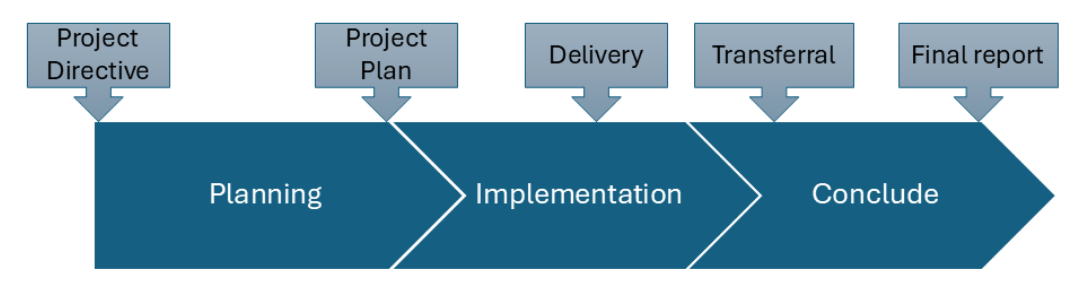
<p>The Puhuri three-stage model is a further development of NeIC’s standard project model where the project ends with a transferral and closure.</p>

<p align="center">
<img class="center" src="/assets/images/news/blog_202503_01.png" /> </p>
<p align="center"><i>Diagram 1: NeIC project model begins by defining the project outcome targets and then defining the content in a more detailed project plan, which is kept updated. The delivery and transfer process depends on the different projects.</i></p>

<p>The Puhuri2 project has developed key recommendations for the successful handover of its results to the receiving organization. These recommendations also apply to similar projects that are planning a service transfer and handover process.</p>

<p>The receiving organization should establish clear handover responsibilities covering governance, documentation migration, service operations, contract transfers or terminations, and necessary skill sets to ensure a smooth transition.</p>

<p>For similar projects, early planning is essential. Defining roles and responsibilities, implementing a structured transfer process, and maintaining effective communication and up-to-date documentation are crucial for a seamless transition and ongoing operational success.</p>

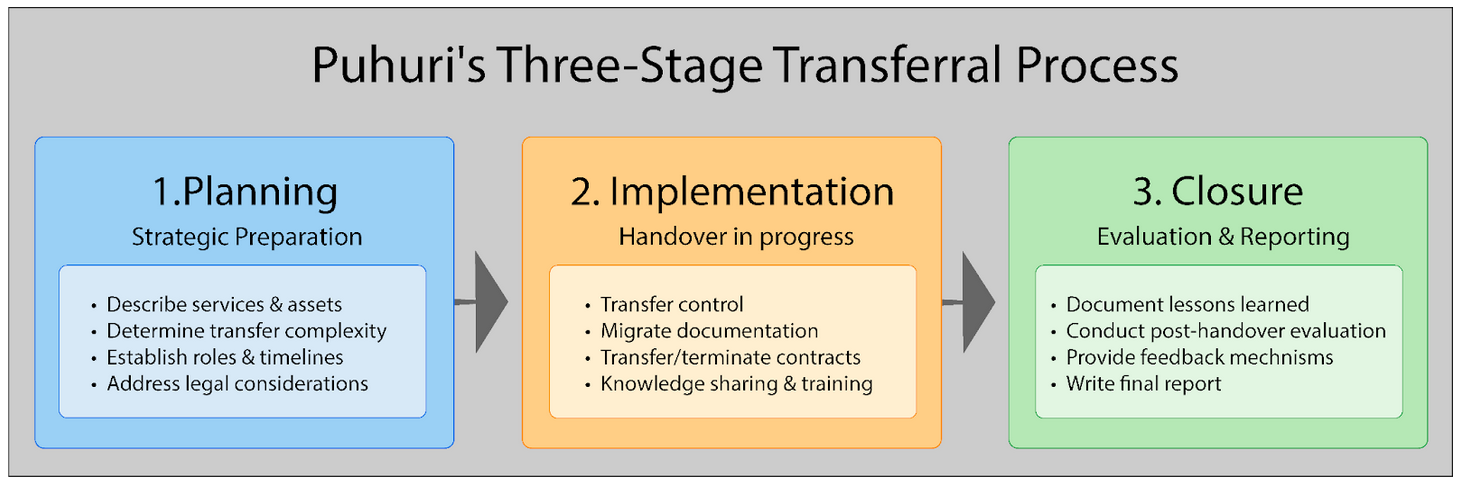
<p><strong>Puhuri’s Three-Stage Transferral Process:</strong></p>

<ol>
  <li>
    <p><strong>Planning:</strong> The goal is to lay a solid foundation for a smooth transition.</p>

    <ul>
      <li>This initial stage focuses on strategic preparation. It involves defining the receiving organisation’s capabilities, selecting a suitable recipient, and conducting thorough negotiations.</li>
      <li>Key activities include:
        <ul>
          <li>Describing Puhuri’s services and assets.</li>
          <li>Determining the complexity of the transfer.</li>
          <li>Establishing clear roles, responsibilities, and timelines.</li>
          <li>Addressing legal and ethical considerations (GDPR, IPR).</li>
          <li>Develop a structured timeline (e.g., a Gantt chart).</li>
        </ul>
      </li>
    </ul>
  </li>
  <li>
    <p><strong>Implementation:</strong> This is the action-oriented stage where the actual handover occurs.</p>

    <ul>
      <li>Key activities include:
        <ul>
          <li>Transferring steering and operational control.</li>
          <li>Migrating documentation and service operations.</li>
          <li>Transferring or terminating existing contracts.</li>
          <li>Ensuring skillset transfer through training and knowledge sharing.</li>
          <li>Using checklists to ensure all items are transferred.</li>
        </ul>
      </li>
      <li>Effective communication and collaboration between Puhuri and the receiving organisation are crucial.</li>
    </ul>
  </li>
  <li>
    <p><strong>Closure:</strong> This final stage focuses on evaluating the transferral process and formally closing the project. The goal is to ensure a successful transition and identify areas for improvement. A NeIC Project is required to deliver a final report. Its content can be used as lessons learned. Naturally, it is not certain that new projects have been analysed and used all experience, but the NeIC’s project owners have experience.</p>

    <ul>
      <li>Key activities include:
        <ul>
          <li>Documenting lessons learned.</li>
          <li>Conducting post-handover evaluations.</li>
          <li>Providing feedback mechanisms for both parties.</li>
          <li>Writing a final report.</li>
        </ul>
      </li>
    </ul>
  </li>
</ol>

<p align="center">
<img class="center" src="/assets/images/news/blog_202503_02.png" /> </p>
<p align="center"><i>Diagram 2: Puhuri’s Three-stage transferral process. The actions in the implementation phase shall occur in an appropriate phase within the project timeline.</i></p>

<h2 id="legal-and-contractual-considerations">Legal and Contractual Considerations</h2>

<p>Conducting legal due diligence, securing necessary approvals, and updating contracts are crucial to ensure a smooth transition. This work should not be performed at the end of the project but be a vital part from the onset to ensure that problems do not arise.</p>

<p>The final transition of Puhuri can, from a judicial perspective, be seen as a transition on several levels. The transition of Puhuri from a framework of research-project/ temporary project phase to a permanent infrastructure solution, a transition from a cooperation project between members of NeIC to CSC as a legal entity and a transition from a non-legal entity to a legal entity.</p>

<p>These transitions represent several legal challenges. These issues typically involve contractual obligations, compliance, and financial liabilities. Below are listed some key legal concerns in such a transfer, even though not all of the issues have been relevant for Puhuri:</p>

<p><strong>1. Contractual and Ownership Issues</strong></p>

<ul>
  <li>Project establishing: When establishing the project, make sure to consider the purpose carefully to avoid a contract format that is not suitable for the project’s purpose.</li>
  <li>Project Contracts: Contracts from the project phase do not automatically cover the conversion to the permanent phase, requiring renegotiation.</li>
  <li>Ownership Rights: Ensuring a clear legal transfer of assets, liabilities, and responsibilities from the project entity to the permanent infrastructure owner.</li>
  <li>Intellectual Property (IP) Rights: When the project involves IPR, legal ownership of materials must be clarified</li>
  <li>Governance: Determining who governs the project and the mandate of each project participant.</li>
  <li>Contracts with a third party: Transferal of an existing contract with a third party if a continuation of collaboration is wanted.</li>
</ul>

<p><strong>2. Regulatory and Compliance Issues</strong></p>

<ul>
  <li>Regulation and compliance issues: A transition of ownership can have a regulatory and compliance impact due to different national laws or the parties changing roles e.g. compliance with GDPR.</li>
  <li>The GDPR processor and controllership may change during the handover if the services process personal data. In that case, an update, for example, to the Data Processing Agreement, Privacy Notice and communication towards the Data Subject is needed.</li>
</ul>

<p><strong>3. Financial issues</strong></p>

<ul>
  <li>Funding Agreements: The transition may involve new financing structures, requiring legal clarity on debt, ownership, and repayment terms.</li>
</ul>

<h2 id="project-handover-checklist">Project Handover Checklist</h2>

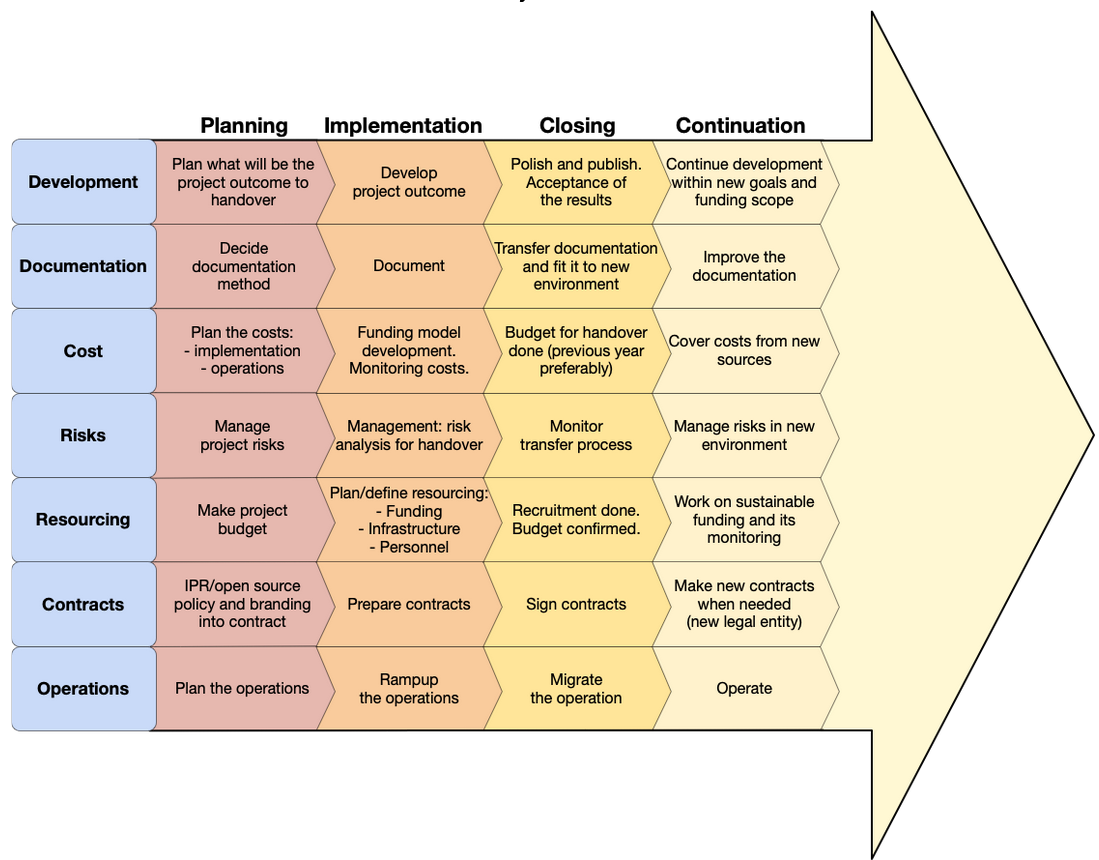
<p>The diagram displayed in the image presents a structured approach to transitioning projects from development to ongoing operations. This framework addresses seven key dimensions across four project phases.</p>

<p>The framework recognises that projects do not simply end but evolve into operational entities or get handed to new teams. By mapping activities across Development, Documentation, Cost, Risks, Resourcing, Contracts, and Operations dimensions, it creates a comprehensive roadmap for successful transitions.</p>

<p>Each dimension progresses through Planning (establishing initial requirements), Implementation (creating deliverables), Closing (formalising handover), and Continuation (sustaining operations). Notable elements include planning for handover from the beginning, ensuring knowledge transfer through documentation, managing financial transitions between fiscal periods, addressing handover-specific risks, confirming resource allocations, handling contractual requirements, and maintaining operational continuity.</p>

<p>This systematic approach helps organisations preserve project value beyond traditional delivery milestones by explicitly planning for the transition from inception, reducing handover friction, and maintaining momentum as projects evolve into their next phase.</p>

<p>NeIC piloted an affiliate model where a small amount of funding could be applied to support the benefit realisation activities after the Project finishes.</p>

<p align="center">
<img class="center" src="/assets/images/news/blog_202503_03.png" /> </p>
<p align="center"><i>Diagram 3: Project handover checklist.</i></p>

<p>In essence, Puhuri’s process emphasises meticulous preparation, active implementation, and thorough evaluation to ensure a seamless and sustainable transfer of its e-infrastructure services.</p>

<h2 id="neic-project-practices-and-survey-results">NeIC project practices and survey results</h2>

<p>Six NeIC projects, both current and former, provided a valuable snapshot of common practices and challenges for this blog post. The survey revealed several key trends regarding project transferral and sustainability.</p>

<p><strong>Key Findings:</strong></p>

<ul>
  <li><strong>Project Continuation and Governance:</strong>
    <ul>
      <li>A majority of projects experienced continuation of their outcomes, often through further funding or integration into other initiatives.</li>
      <li>However, a significant portion lacked a clear plan for future governance, highlighting a disconnect between project continuation and structured sustainability.</li>
    </ul>
  </li>
  <li><strong>Lack of Formal Handover Processes:</strong>
    <ul>
      <li>A striking finding was the absence of formal handover checklists or plans in most projects.</li>
      <li>This suggests a widespread need for standardised procedures to facilitate smoother transitions.</li>
    </ul>
  </li>
  <li><strong>Identifying Handover Elements:</strong>
    <ul>
      <li>While most projects didn’t struggle to identify handover elements, some faced challenges, particularly with intangible outcomes like knowledge and algorithms.</li>
    </ul>
  </li>
  <li><strong>Role and Responsibility Clarity:</strong>
    <ul>
      <li>Identifying post-project leadership and responsibility proved challenging for some, indicating a need for clearer role definitions beyond the initial project phase.</li>
    </ul>
  </li>
  <li><strong>Recipient Capabilities:</strong>
    <ul>
      <li>Defining recipient capabilities was generally not a major hurdle, but some projects noted broader difficulties in defining necessary skills.</li>
    </ul>
  </li>
  <li><strong>NeIC’s Role:</strong>
    <ul>
      <li>NeIC’s contribution to future governance varied, with some projects reporting valuable support and others noting its absence.</li>
    </ul>
  </li>
  <li><strong>Handover Success and Challenges:</strong>
    <ul>
      <li>While some projects reported successful handovers, challenges persisted, including maintaining project member engagement and transitioning to operational models.</li>
    </ul>
  </li>
  <li><strong>Documentation and Knowledge Transfer:</strong>
    <ul>
      <li>Most projects documented knowledge and lessons learned, but the level of formality and accessibility varied.</li>
      <li>Most projects did benefit from previous projects.</li>
    </ul>
  </li>
  <li><strong>Deliverable Ownership:</strong>
    <ul>
      <li>There were mixed results on the clarity of deliverable ownership after handover, highlighting a potential area for improved clarity in project agreements.</li>
    </ul>
  </li>
  <li><strong>Funding Model Suitability:</strong>
    <ul>
      <li>Most projects felt the project-based funding scheme was more suitable than an operational infrastructure funding and service owner model.</li>
    </ul>
  </li>
  <li><strong>Resourcing of the continuation</strong>: As the funding may be reduced and the priorities may change, the involved people will also change.</li>
</ul>

<h2 id="summarisation-and-recommendations">Summarisation and recommendations</h2>

<p>In Puhuri 2, governance and sustainability are one of the key focus areas. For any collaborative infrastructure project, sustainability is crucial for long-term success. Addressing governance early is essential. Even when the intended recipient of project outcomes is clear from the beginning, continuation becomes suboptimal without proper foundations for ownership transition.</p>

<p>Since NeIC projects aren’t legal entities, identified contractual issues must be resolved between organisations, and if necessary, a legal entity must be decided upon when the project is established. In the Puhuri 2 project, an agreement was made between the partners to agree on a legal entity in the form of a Guardian. The aspects of a Guardian were described in the collaboration agreement.</p>

<p>While NeIC funded development projects are Puhuri’s original target customers, operational services are funded by national providers rather than NeIC. These service owners are, therefore, key stakeholders, and Puhuri must continue supporting them. Given the Puhuri services added value to a wider range of service providers, transferring the service from development to governance and operations requires a transparent, robust process to ensure sustainable maintenance for the foreseeable future.</p>

<p>Puhuri project collaborated with NeIC Project Managers to develop policies, methodologies, and collaborations that can benefit future NeIC projects. By sharing our insights, we hope to empower other projects to build sustainable legacies and contribute to the advancement of collaborative e-infrastructure.</p>

<p>As Puhuri 2 concludes, we offer these questions for the broader e-infrastructure community:</p>

<ol>
  <li>
    <p>How can we collectively build a more sustainable future for research e-infrastructures?</p>
  </li>
  <li>
    <p>What challenges have you faced in ensuring the long-term sustainability of your projects?</p>
  </li>
</ol>]]></content><author><name></name></author><summary type="html"><![CDATA[Beyond Development - Building Sustainable E-Infrastructure Through Effective Handover]]></summary></entry></feed>